
Precious metals have long been viewed as simple hedges against uncertainty. A closer look reveals something far more intricate: a system of interlocking pressures in which each disruption amplifies the next.
In complexity theory, a cascade failure occurs not because any single stress exceeds a system’s tolerance, but because stresses arrive in sequence, each one narrowing the margin available to absorb the next. Financial markets are rarely studied this way. Analysts tend to isolate variables, policy changes here, supply shocks there, as though markets respond to stimuli one at a time. Precious metals, however, offer a compelling case study in why that assumption breaks down. Gold and silver sit at the intersection of monetary policy, industrial supply chains, speculative capital, and geopolitical risk. When pressures in each of those domains align, the result is not merely additive. It is exponential.
The sequence examined here is, by design, hypothetical. But its components are drawn from dynamics already visible in markets today. Taken together, they illustrate a principle that regulators, portfolio managers, and corporate treasurers would do well to internalize: in tightly coupled systems, the origin of a disruption matters far less than the order in which its consequences arrive.
The First Domino: Regulatory Constraint and the Compression of Paper Markets
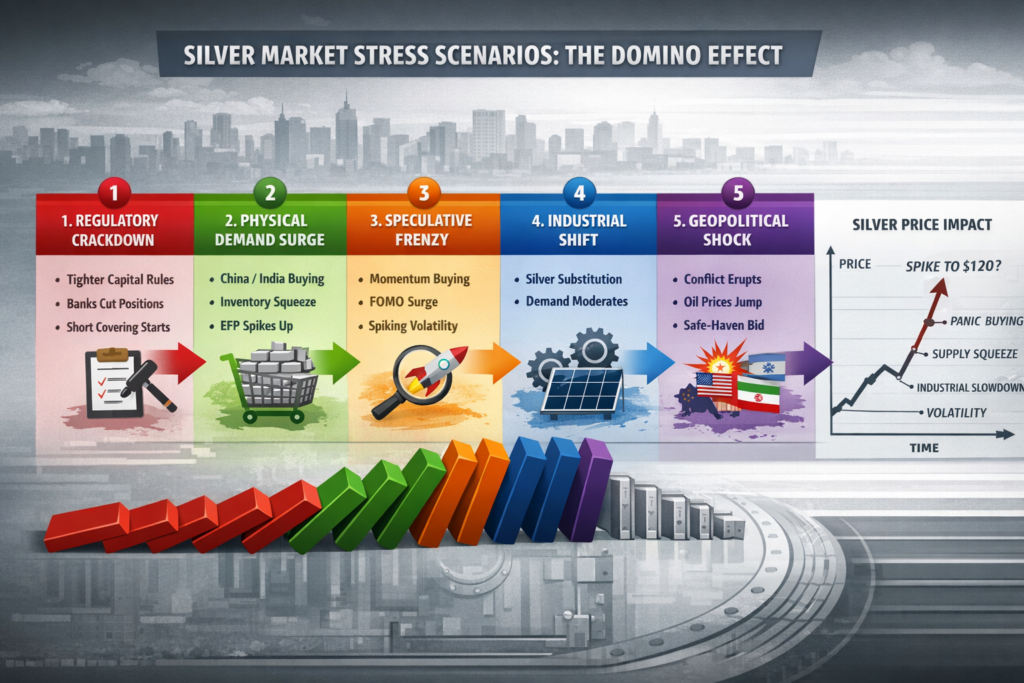
The story begins not in a trading pit, but in a conference room. Regulators, responding to post-crisis vulnerabilities and the persistent opacity of derivatives exposure, announce tighter capital requirements and enhanced scrutiny of commodity-linked instruments. The announcement is measured, the timeline gradual. And yet the market reaction is immediate.
This is not irrational. Banks and prime brokers, suddenly facing a higher cost of capital for maintaining large positions in precious metals derivatives, begin unwinding. The compression is orderly at first. But silver, whose paper market is proportionally far larger relative to physical supply than gold’s, experiences acute short-covering pressure as institutions reduce net exposure. Futures contracts move into flux. Bid-ask spreads widen. The cost of maintaining a silver hedge rises.
Gold, too, reacts. But its response is more measured, reflecting its deeper integration into central bank reserves and its historically more liquid secondary market. Where silver experiences dislocation, gold undergoes recalibration. The distinction matters. It reveals that the two metals, though often discussed in tandem, respond to institutional pressure through entirely different mechanisms. Gold is a monetary instrument wearing the costume of a commodity. Silver is the reverse.
What the regulatory domino reveals is less about the specific policy than about the brittleness concealed beneath apparent normalcy. Markets in equilibrium often look robust. They are frequently not.
The Second Domino: Physical Scarcity and the Backwardation Signal
Before the regulatory ripple has fully settled, a second pressure emerges from an altogether different direction. Industrial buyers, electronics manufacturers, solar panel producers, medical device companies, accelerate procurement. Some are responding to supply chain lessons learned painfully during recent years of disruption. Others are simply reacting to the forward price signals already distorted by the first domino. Collectors and smaller investors, sensing momentum, add incremental demand.
Silver inventories, which had been tightening for several quarters, move toward critically low levels in the warehouses underpinning major futures exchanges. The market enters backwardation, a condition in which the spot price exceeds the futures price, inverting the normal carry relationship. This is not a technical curiosity. Backwardation in commodity markets is a distress signal. It indicates that the market values immediate physical delivery more than deferred supply, which occurs when participants fear that future availability cannot be guaranteed.
Futures premiums rise. The competition for physical silver intensifies. Refiners that might otherwise serve as a buffer face their own constraints in ramping capacity. The scarcity, initially structural, becomes reflexive: rising prices deter some buyers while simultaneously validating the urgency of others.
Gold’s physical market, by contrast, remains more liquid. The metal is not consumed industrially in significant quantities; what is sold is largely recycled back into the system. Its above-ground stockpile, estimated at roughly 200,000 tonnes globally, provides a buffer that silver simply does not have. Nevertheless, gold sees increased investor interest as an alternative store of value, adding modest upward pressure. The second domino has not merely reinforced the first. It has transformed a financial market stress into a supply chain event.
The Third Domino: Speculative Reactivity and the Volatility Spiral
Markets attract capital in proportion to their perceived momentum. When prices move, observers become participants. This is not a flaw in market design; it is an intrinsic feature of price discovery. But in a system already stressed by regulatory compression and physical scarcity, the arrival of momentum-driven capital introduces a destabilizing amplification.
Algorithmic strategies, detecting the convergence of rising premiums, falling inventory signals, and widening spreads, begin accumulating long positions. Stop-loss orders placed by those who had shorted silver during quieter periods trigger automatically as prices breach technical thresholds. Each trigger becomes a micro-catalyst for the next. Leverage, deployed generously in a low-volatility environment, suddenly becomes a liability.
Silver experiences sharp, discontinuous price moves. Intraday ranges that would have been unusual become routine. Margin calls force liquidations that have nothing to do with silver’s underlying supply or demand, they are purely a function of portfolio construction under stress. Gold appreciates as well, but more smoothly. Its larger market depth and the presence of central bank actors with long-term mandates provide a natural stabilizer.
The speculative domino is important for a reason that extends beyond price action. It is the moment at which the cascade becomes self-referential. The original stresses, regulatory and physical, had external causes. The speculative reaction is generated entirely from within the market itself. This is the signature of a complex system under pressure: the system begins producing its own inputs.
The Fourth Domino: Industrial Adaptation and the Countervailing Force
Not all dominoes push in the same direction. This is among the most important and underappreciated insights available to students of market cascades.
As silver prices rise and supply tightens, manufacturers do what rational economic actors always do: they adapt. Substitution accelerates where technically feasible, thinner silver coatings, alternative conductive materials, redesigned components. Where substitution is not possible, production is scaled back or orders are deferred. The cumulative effect is a reduction in marginal industrial demand that partially offsets the upward price pressure generated by speculative and physical scarcity dynamics.
This is not a reversal. It is a dampening mechanism. The industrial adaptation domino falls not to accelerate the cascade but to moderate it, introducing friction that prevents the system from reaching its most extreme possible state. Markets with this kind of built-in countervailing force are more resilient than those without it, but they are also more difficult to model, because the stabilizing response is conditional, delayed, and unevenly distributed across industries.
Gold, less dependent on industrial demand, is largely unaffected by this particular mechanism. Its price dynamics at this stage are driven primarily by the investor behavior established in earlier stages. The divergence between the two metals becomes more pronounced: silver is caught between speculative energy pulling prices upward and industrial adaptation pulling them down, while gold moves along a cleaner trajectory shaped by monetary and safe-haven considerations.
The Fifth Domino: Geopolitical Shock and the Full Chain
The final pressure arrives from outside the financial system entirely. Geopolitical escalation, in this scenario, rising tensions in a region critical to global energy markets, triggers a classic flight-to-safety response. Equity volatility rises. Credit spreads widen. Investors who had been contemplating precious metals exposure act.
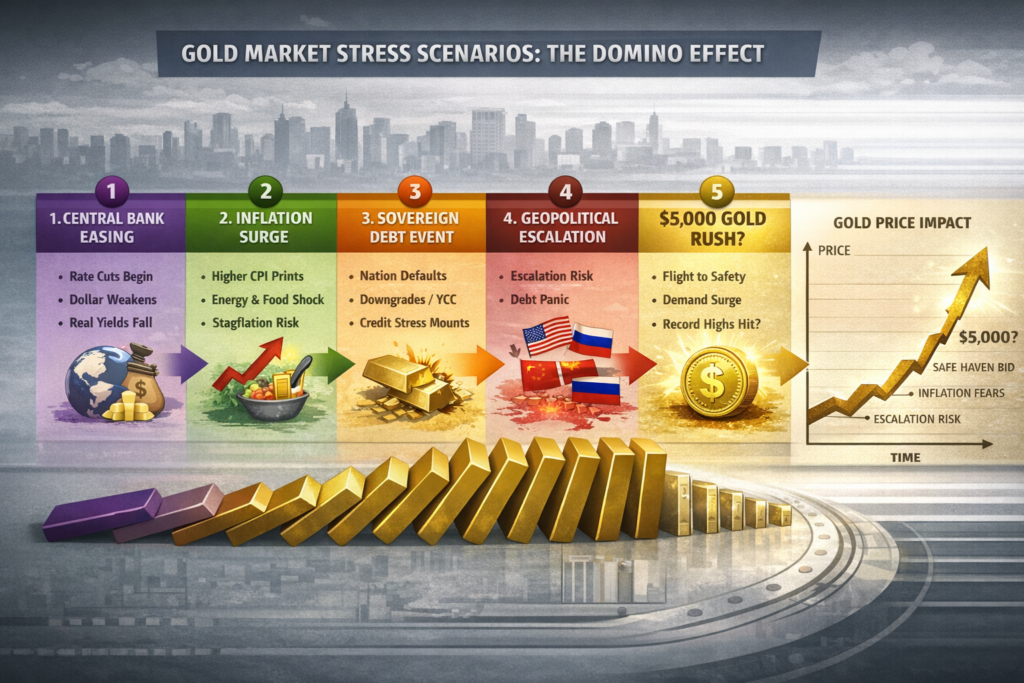
Gold surges. Its role as a monetary reserve asset, independent of industrial cycles and less vulnerable to supply disruption than most commodities, makes it the natural beneficiary of risk-off sentiment. Central banks in emerging markets, already diversifying away from dollar concentration, add incrementally to reserves. Sovereign wealth funds rebalance. The move is not merely speculative, it is structural capital reallocating toward perceived safety.
Silver’s response is more ambiguous. It initially follows gold’s upward move, carried by the same safe-haven impulse and by the momentum already established through earlier stages of the cascade. But its industrial identity moderates the rally. If geopolitical escalation implies a global economic slowdown, the demand destruction effect on silver’s industrial applications tempers investor enthusiasm. The metal rises, but less than gold. The spread between the two widens.
By the time the fifth domino has fallen, the market has moved through five distinct but interlocking phases. Each one altered the conditions under which the next arrived. The cascade is not a straight line. It is a branching, adaptive sequence in which the final state could not have been predicted from any single input.
What This Tells Us About Modern Markets
The domino framework is useful not because markets actually fall in neat sequence, but because it forces analysts to think about interactions rather than variables in isolation. Several conclusions follow from this exercise.
Tightly coupled systems fail differently than loosely coupled ones. Silver’s deeper vulnerability throughout this sequence reflects its simultaneous exposure to monetary, industrial, and speculative dynamics. The more integration points a market has, the more pathways a cascade can travel.
The origin of a stress matters less than its timing relative to existing vulnerabilities. A regulatory announcement that would have been absorbed easily in a period of ample inventory and low leverage becomes a catalyst in a different context. Fragility is not a property of shocks. It is a property of systems.
Countervailing forces are real but conditional. Industrial adaptation provided genuine stabilization in the fourth stage. But it required time to materialize, and it was uneven across industries. Models that assume instantaneous equilibrating responses will consistently underestimate peak volatility.
Gold and silver are not the same asset with different price tags. Treating them as interchangeable, in portfolio construction, in regulatory analysis, or in macroeconomic modeling, obscures the fundamentally different mechanisms through which each responds to stress. The divergence between them, across each stage of this scenario, is itself information.
For institutional investors, the practical implication is a higher standard of scenario analysis, one that accounts not just for the probability of individual shocks but for their potential sequencing. For regulators, it is a reminder that interventions in complex systems rarely produce only their intended effects. And for corporate treasurers managing commodity exposure, it is a case for maintaining physical inventory buffers that financial hedges alone cannot replicate.
The dominoes, once set in motion, do not care about the models built to contain them.